Nido
An inclusive pregnancy app that adapts to each situation — IVF, ROPA, multiple pregnancy, chronic illness — and to whether you're carrying the baby or supporting the person who is.
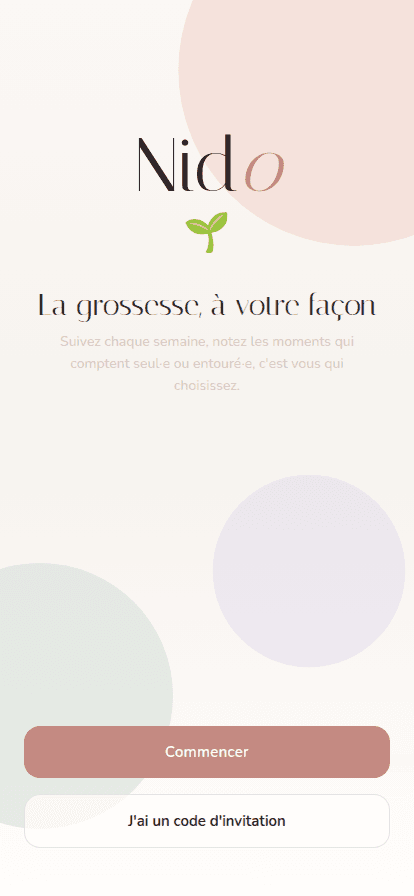
Welcome 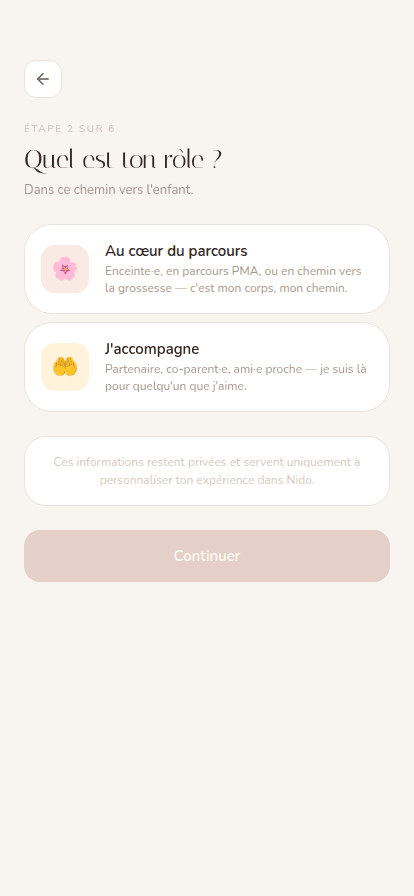
Who you are in this 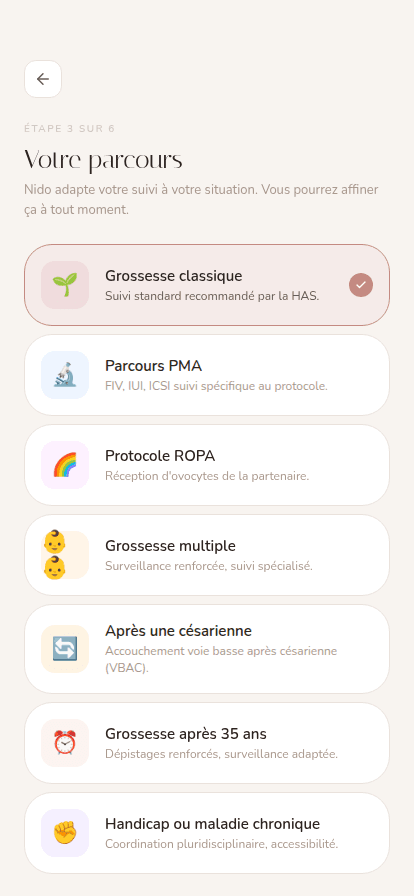
Your pregnancy path
Overview
Nido is a mobile app for following a pregnancy week by week: tracking, journal, checklist, baby names, baby movements and appointments. Instead of assuming one standard pregnancy, it starts by asking who you are and what your path looks like, and adapts from there. It's in beta and has been tested with a small group of users.
Problem
Most pregnancy apps are built around one traditional, mother-centred model, and everything else is an edge case. People going through IVF, a ROPA protocol, a pregnancy after a caesarean or with a chronic illness don't see themselves in them, and partners are usually an afterthought.
What I built
- A six-step onboarding that asks for your role and your pregnancy path before showing anything else.
- Seven paths to start from: standard pregnancy, IVF/ART, ROPA protocol, multiple pregnancy, after a caesarean, after 35, disability or chronic illness.
- Two roles: the person at the heart of the pregnancy, and the person who accompanies them — partner, co-parent, close friend.
- Invitations by code, so someone can join your “cocoon” or you can carry on alone and invite them later.
- Week-by-week tracking, a journal, a checklist, baby names, baby movements and appointments.
Technical decisions
Model the situations, not one happy path
The pregnancy path is chosen up front and can be refined at any time, and the tracking adapts to it. Treating IVF, ROPA or a chronic illness as starting points rather than edge cases is the core product decision behind Nido.
Two roles in the same space
The pregnant person and the person accompanying them share a cocoon but don't have the same place in it. So the app asks for the role explicitly, keeps that answer private, and the copy is written for both.
Lots of features, simple navigation
Weeks, journal, checklist, names, movements, appointments: that's a lot for one app. Most of the work was deciding what sits at the top level and what can wait one tap, so it stays light on a normal day.
Personal data that has to last
People write things down over nine months and expect to find them again. The app is built around their data in Supabase/PostgreSQL, with React Native, Expo and Expo Router so one TypeScript codebase ships to iOS and Android.